#Psychedelic
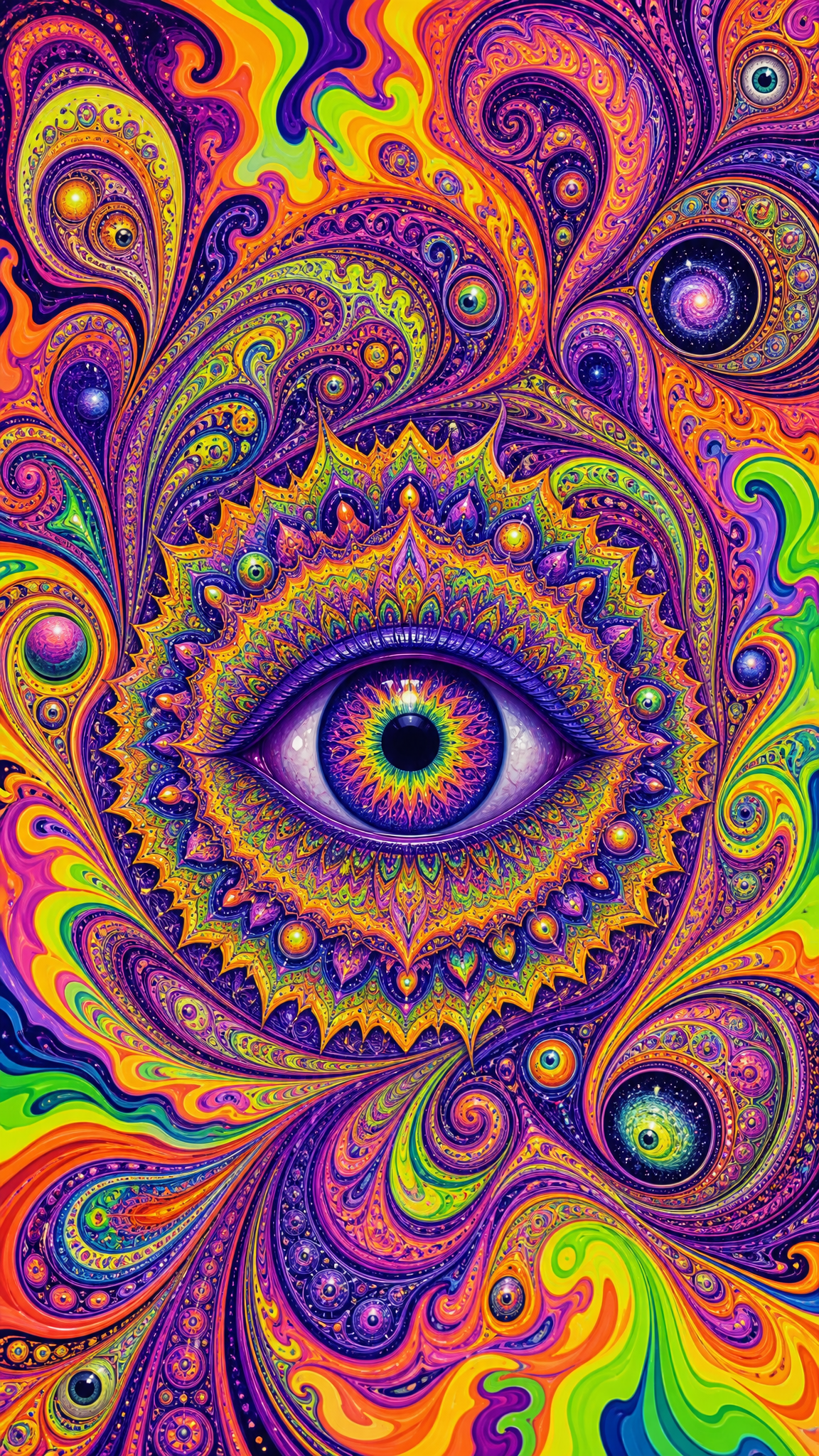
Psychedelic wallpapers channel the mind-expanding visual language of the 1960s counterculture through vibrant saturated colors, fractal patterns, kaleidoscopic compositions, and optical illusions. Born from the San Francisco poster art movement and concert visuals of the psychedelic era, this style transforms screens into portals of swirling color and mesmerizing pattern. Every element pulses with energy — warped typography, morphing organic forms, and colors that seem to vibrate against each other create an unmistakable sensory intensity.
Psychedelicアートについて
Psychedelic art emerged from the late 1960s counterculture, directly inspired by the visual experiences of psychedelic substances. The term 'psychedelic' meaning 'mind revealing' was coined by British psychologist Humphry Osmond. The San Francisco poster movement was led by 'The Big Five' artists: Wes Wilson (1937-2020), who invented the iconic melting psychedelic font around 1966 and designed posters for Bill Graham's Fillmore; Victor Moscoso (born 1936), the first academically trained rock poster artist whose vibrating color technique was influenced by Josef Albers at Yale; along with Alton Kelley, Rick Griffin, and Stanley Mouse. Wilson's style was heavily influenced by Art Nouveau, and his melting letterforms became synonymous with the peace movement and the psychedelic era.
ビジュアルの特徴
- Vibrating complementary color combinations at full saturation
- Kaleidoscopic radial symmetry and mirrored patterns
- Fractal-like recursive patterns with infinite detail
- Organic morphing forms: melting, flowing, breathing shapes
- Warped and melting typography that challenges readability
- Concentric circles, spirals, and optical illusion patterns
- Paisley and mandala motifs as structural elements
- Extreme color contrast with no neutral zones
- Horror vacui: every surface filled with swirling detail
- Phosphene-inspired patterns: dots, grids, tunnels
- Liquid, flowing gradients between contrasting hues
- Collage elements merging photographic and illustrated imagery
活用例
Bold desktop wallpapers for music enthusiasts and creative professionals
Festival and event app backgrounds requiring high-energy visuals
Phone lock screens that make a strong visual statement
Retro-themed digital environments celebrating 1960s-70s culture
Gaming and streaming setup wallpapers complementing RGB aesthetics
Music player app backgrounds for psychedelic rock and electronic genres
類似スタイル
異なる点
プロンプトガイド
プロンプトの方向性
- Specify vibrating color pairs: 'complementary colors at maximum saturation — magenta against lime green, orange against electric blue, creating optical vibration'
- Request kaleidoscopic structure: 'radially symmetric mandala pattern with fractal recursive detail at every scale'
- Describe organic movement: 'flowing, melting forms that appear to breathe and pulse, no straight lines or sharp edges'
- Layer pattern density: 'horror vacui composition — every surface covered with swirling paisleys, spirals, and concentric circles'
- Reference the movement directly: '1960s San Francisco psychedelic poster style with Wes Wilson-inspired melting letterforms'
- Add optical illusion effects: 'Moiré patterns and op-art vibration effects that create a sense of visual motion'
ヒント
- Internal editorial suggestion: psychedelic wallpapers pair naturally with music-related search queries — include concert/festival context in page copy
- Internal editorial suggestion: the 'trippy' keyword has high search volume but lower competition — use strategically in metadata
- Internal editorial suggestion: cross-link with retro, abstract, and neon tags for discovery clustering
- Internal editorial suggestion: psychedelic's 1960s history provides rich editorial content for long-form blog posts driving organic traffic
おすすめキーワード
避けること
よくある失敗
- Producing generic colorful gradients without structure — psychedelic needs specific motifs (fractals, mandalas, spirals) not random color blobs
- Colors that are bright but not vibrating — true psychedelic uses complementary color pairs at equal saturation to create optical tension
- Too much symmetry becoming mechanical — psychedelic patterns have organic imperfection even within radial symmetry
- Missing the horror vacui principle — leaving empty space breaks the immersive, all-encompassing quality of psychedelic composition