#Space
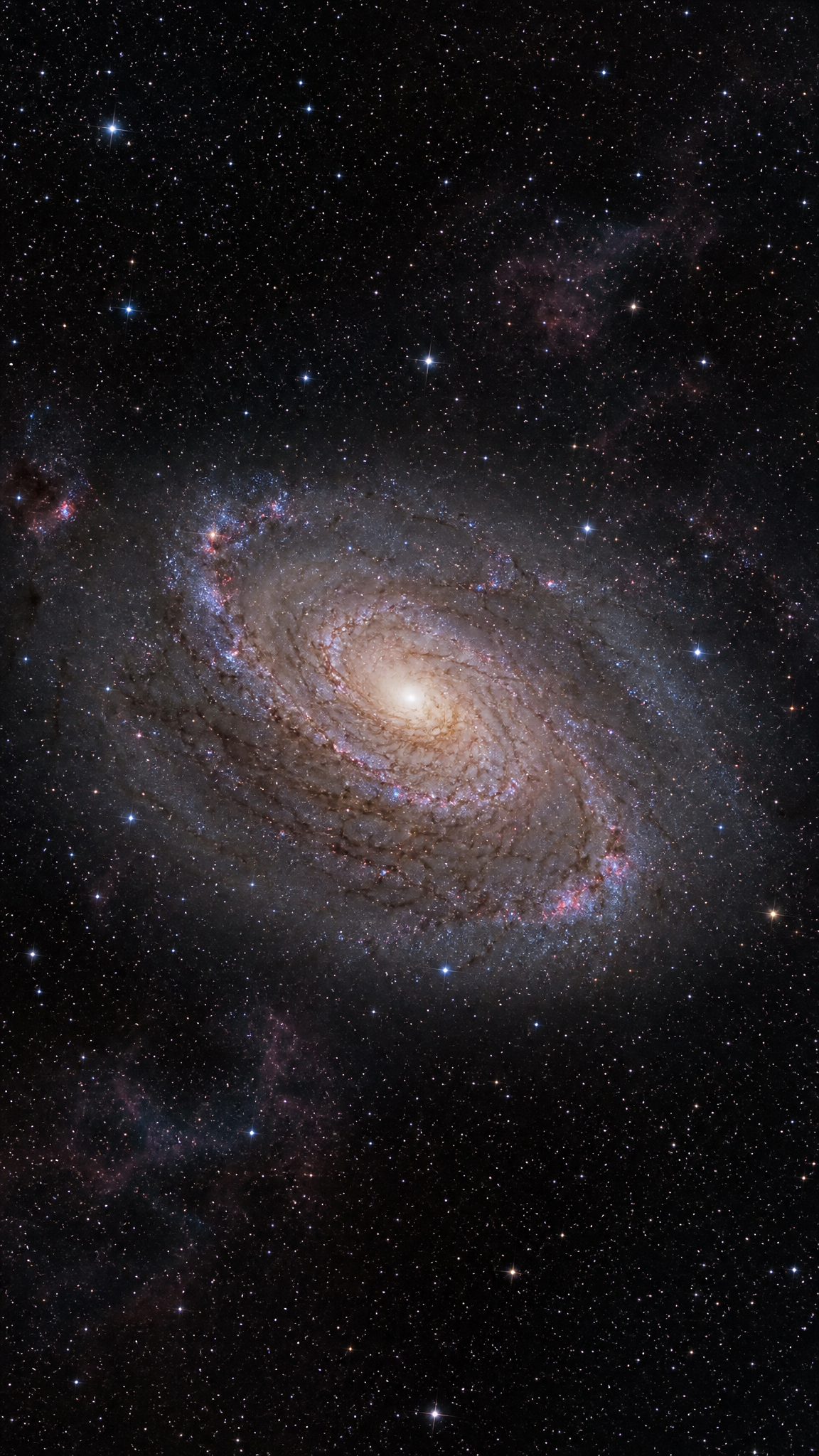
Space art (astronomical art) is a visual genre depicting the universe, outer space, and cosmic phenomena. The genre ranges from scientifically grounded visualizations inspired by NASA/Hubble/JWST imagery to imaginative artistic interpretations of nebulae, galaxies, and alien worlds. Modern space art was pioneered by Chesley Bonestell in 1944. As a wallpaper style, space delivers dramatic compositions with deep black backgrounds, vivid nebula colors, and dramatic scale contrasts — making it one of the most popular genres for OLED/AMOLED screens and dark-mode setups.
Spaceアートについて
Space art as a recognized genre was born in 1944 when Chesley Bonestell (1888-1986) published his painting 'Saturn as Seen from Titan' in Life magazine. Space policy expert Howard E. McCurdy stated: 'No artist had more impact on the emerging popular culture of space in America than Chesley Bonestell.' Carl Sagan said: 'I didn't know what other worlds looked like until I saw Bonestell's paintings.' Bonestell and Willy Ley published 'The Conquest of Space' in 1949 (winner of the 1951 International Fantasy Award). In the 1950s, science fiction magazines (Astounding/Analog, Galaxy, Amazing) and picture magazines (Life, Collier's) became major platforms. Bonestell collaborated with Wernher von Braun on the influential Collier's 'Man Will Conquer Space Soon!' series (1952-1954). NASA administrator James E. Webb established NASA's official Space Art program in 1962. The International Association of Astronomical Artists (IAAA) was founded in 1982. The 1990 launch of the Hubble Space Telescope transformed the public visual vocabulary of space — Hubble imagery (Pillars of Creation, deep field images) became the dominant reference for how people imagine space looks. Other founding figures include Lucien Rudaux (French, earlier astronomical illustrator), R.A. Smith (British), David A. Hardy, and Ludek Pesek.
ビジュアルの特徴
- Deep black backgrounds — the void of space as dominant negative space
- Point-source lighting — stars and suns creating dramatic illumination with sharp shadows
- Nebula color palettes — rich purples, teals, magentas, warm oranges inspired by Hubble/JWST false-color processing
- Scale contrast — tiny spacecraft or figures against vast cosmic structures
- Atmospheric glow and haze — planetary atmospheres, nebula edges, stellar halos
- Dense star fields creating depth and texture across the composition
- Two major approaches: realistic/scientific (accurate planets, star fields, orbital mechanics) and artistic/fantastical (exaggerated nebulae, iridescent swirls, sci-fi elements)
- Layered colors and shapes blended to achieve diffuse nebula appearance
- Gradients creating three-dimensionality — from bright stellar cores to dark space edges
- Planetary surface landscapes with alien skies and multiple moons/suns
- Ring systems, asteroid belts, and orbital debris as compositional elements
- Light streak effects — meteor trails, comet tails, warp speed lines
活用例
OLED/AMOLED mobile screens — true black backgrounds turn off pixels, saving battery while creating striking nebula/star contrast
Desktop (16:9) — nebula panoramas, planetary vistas, and star fields fill widescreen naturally
Ultrawide (21:9) — panoramic space scenes (asteroid belts, ring systems, nebula fields) suit ultrawide aspect ratios
Dark mode / productivity setups — predominantly dark palette reduces eye strain for extended use
Dual/triple monitor — continuous star fields or nebula panoramas span multiple screens seamlessly (no hard horizon lines)
Mobile lock screens (9:16) — vertical compositions: planet centered with nebula above and below, or rocket ascending
High resolution (4K+) — star fields and nebula detail reward high resolution; fine star points appear pixelated at lower resolutions
類似スタイル
異なる点
プロンプトガイド
プロンプトの方向性
- Start with a cosmic scene: 'deep space nebula,' 'alien planet surface with ringed gas giant,' 'asteroid belt panorama'
- Specify the approach: 'realistic astronomical' for NASA-inspired, 'artistic space' for more fantastical interpretations
- Add color direction: 'Hubble-inspired colors,' 'purple and teal nebula,' 'warm orange cosmic dust'
- Include scale elements: 'tiny spacecraft silhouette,' 'planet looming over lunar surface,' 'enormous gas giant filling the sky'
- For atmospheric depth: 'stellar haze,' 'nebula glow,' 'volumetric cosmic dust,' 'dense star field background'
- Always specify aspect ratio: '--ar 16:9' for desktop, '--ar 9:16' for phone, '--ar 21:9' for ultrawide
ヒント
- Internal editorial suggestion: 'Hubble-inspired' or 'JWST-style' as a modifier anchors the color processing to the most recognizable space imagery reference.
- Internal editorial suggestion: For OLED phone wallpapers, ensure large areas of true black — this is both aesthetically striking and battery-saving on OLED screens.
- Internal editorial suggestion: For desktop wallpapers, nebula panoramas with a clear horizon or planetary surface in the lower third leave icon-friendly space.
- Internal editorial suggestion: Adding 'a tiny spacecraft silhouette' to cosmic scene prompts provides essential scale reference that makes the composition dramatically more impactful.
- Internal editorial suggestion: For ultrawide monitors, 'panoramic asteroid belt' or 'wide nebula field' compositions fill the extended width naturally without feeling stretched.
おすすめキーワード
避けること
よくある失敗
- Making space too colorful overall — real space imagery has selective color in nebulae against vast black emptiness
- Forgetting the black void — deep black negative space is essential; filling everything with color loses the space feeling
- Missing scale references — without something small (spacecraft, astronaut, planet surface) to contrast against, cosmic structures lose their grandeur
- Over-brightening star fields — stars should vary in brightness and color, with most being subtle points
- Producing generic sci-fi instead of space art — space art focuses on the cosmic environment itself, not spaceships and battles