#Art Deco
Art Deco is a decorative arts movement that first appeared in Paris in the 1910s and flourished internationally through the 1920s-1930s. Defined by bold geometric forms — zigzags, sunbursts, chevrons, fan shapes — rich jewel-tone colors, and luxurious materials, the style celebrates modernity, glamour, and machine-age precision. As a wallpaper style, Art Deco delivers elegant, symmetrical compositions with strong pattern repetition, making it exceptionally versatile across screen sizes and particularly suited to users seeking timeless sophistication.
About Art Deco Art
Art Deco first appeared in Paris in the 1910s, just before World War I, and came to maturation at the 1925 Exposition internationale des arts decoratifs et industriels modernes in Paris — the exposition whose name directly yielded the abbreviated term 'Art Deco.' Crucially, the style was NOT called 'Art Deco' during its active period. The term did not appear in print until 1966, in an exhibition title by the Musee des Arts Decoratifs in Paris. British art historian Bevis Hillier popularized it in his 1968 book 'Art Deco of the 20s and 30s' — the first English-language book on the subject. Before that, the style was referred to as 'Art Moderne.' Key architects include Auguste Perret, Henri Sauvage, William Van Alen (Chrysler Building), and Shreve/Lamb/Harmon (Empire State Building). Prominent designers include Emile-Jacques Ruhlmann (furniture), Rene Lalique (glass/jewelry), and Erte (fashion/illustration). The style drew influences from Cubism, Fauvism, the Vienna Secession, the Ballets Russes, and art from ancient Egypt, Maya, Japan, and Persia. Art Deco was explicitly a successor to and reaction against Art Nouveau.
Visual Traits
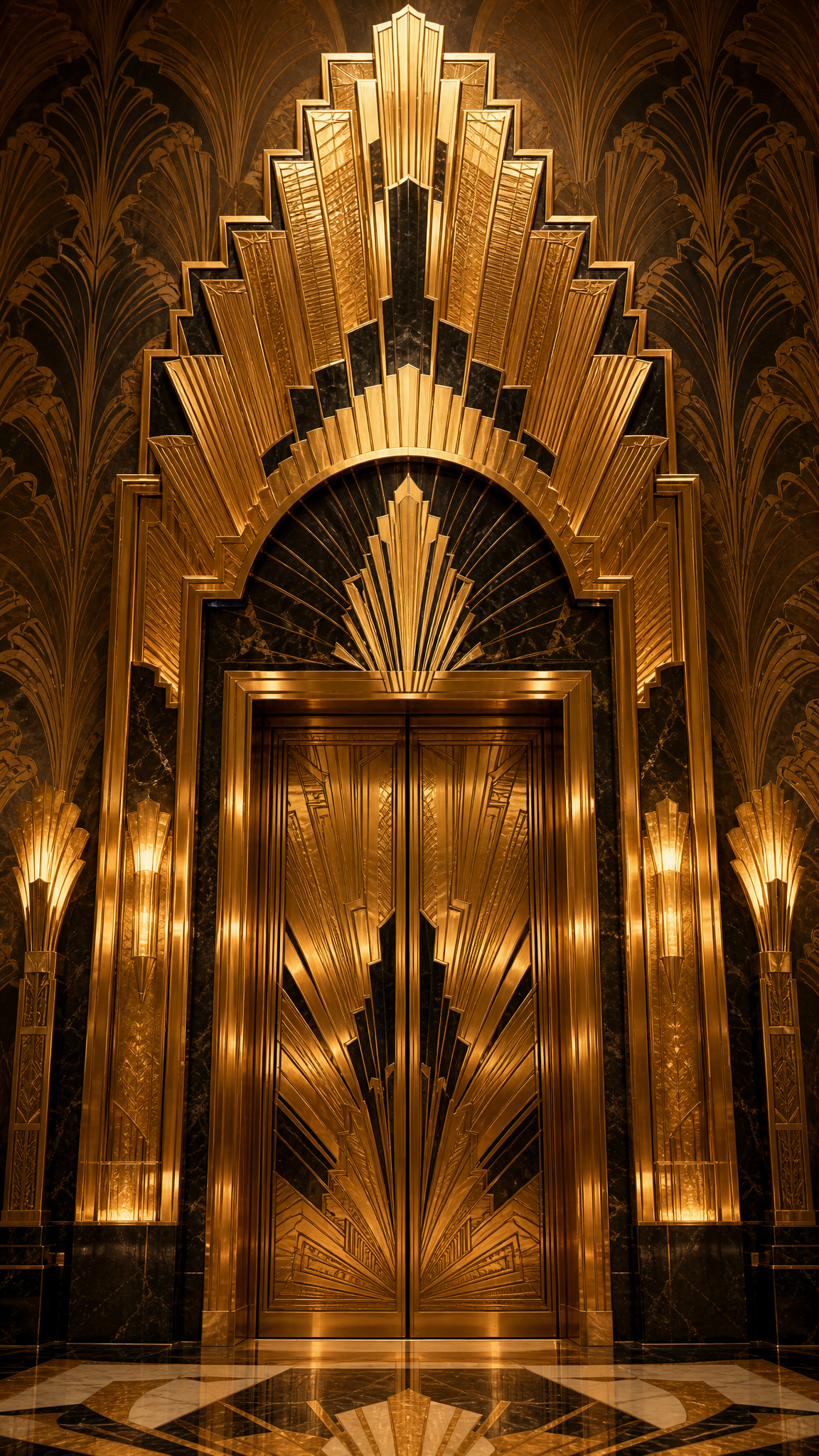
- Bold geometric forms — zigzags, chevrons, sunbursts, fan shapes (palmettes), stepped forms
- Strict symmetry and bilateral balance
- Rich jewel-tone color palette — emerald green, sapphire blue, ruby red, deep gold
- Metallic accents — gold, silver, chrome, brass
- Black-and-white high-contrast compositions
- Stylized natural forms — conventionalized nude female figures, animals (deer, greyhounds, eagles), foliage
- Sunburst and radiating line patterns
- Stepped/ziggurat architectural silhouettes (as seen in skyscrapers)
- Streamlined, aerodynamic curves in later Art Deco / Streamline Moderne
- Geometric sans-serif typography with angular letterforms and strong vertical strokes
- Materials suggesting luxury — chrome, brass, marble, lacquer, exotic woods, glass, mirror
- Repetitive geometric tilework and border patterns
Use Cases
Desktop widescreen (16:9) — repeating geometric patterns tile seamlessly across widescreen displays
Phone screens (9:16) — vertical emphasis of stepped forms and sunbursts naturally suits portrait orientation
Tablet and iPad (4:3) — balanced symmetry of Art Deco patterns works particularly well on near-square displays
Ultrawide monitors (21:9) — architectural photography of Art Deco buildings spans wide formats effectively
Professional and luxury-themed workspaces — the sophisticated aesthetic complements formal environments
Dark mode and light mode — jewel tones on dark backgrounds and gold patterns on cream both work
Similar Styles
Different From
Prompt Guide
Prompt Directions
- Start with a pattern type: 'Art Deco geometric pattern' or 'Art Deco sunburst design' establishes the visual language
- Specify color direction: 'emerald and gold,' 'black and gold geometric,' 'sapphire blue with silver accents'
- Include architectural references for scene compositions: 'Chrysler Building style facade,' 'Art Deco lobby interior'
- Add material textures: 'gold foil,' 'marble and chrome,' 'lacquered finish' for luxury feel
- For seamless patterns, add: 'seamless tileable pattern,' 'repeating geometric wallpaper design'
- Always specify aspect ratio: '--ar 16:9' for desktop, '--ar 9:16' for phone
Tips
- Internal editorial suggestion: Gold-on-black or gold-on-dark-green are the most reliable starting palettes for Art Deco wallpapers. They read as immediately 'Deco.'
- Internal editorial suggestion: For seamless desktop patterns, use 'repeating tile' or 'seamless pattern' modifiers. Fan shapes and chevrons tile particularly well.
- Internal editorial suggestion: Phone wallpapers benefit from vertical stepped/ziggurat forms or a single sunburst motif radiating from center.
- Internal editorial suggestion: Reference specific Art Deco buildings (Chrysler Building, Miami Beach hotels) to anchor the style when generating architectural scenes.
- Internal editorial suggestion: Iterate if results look too 'Victorian' or 'Baroque' — add 'geometric,' 'angular,' 'streamlined' to sharpen toward true Deco.
Recommended Keywords
Avoid
Common Failures
- Confusing Art Deco with Art Nouveau — producing flowing organic curves instead of angular geometric forms
- Using pastel or muted colors — Art Deco demands rich jewel tones and bold metallics
- Making the pattern too irregular or asymmetrical — Art Deco patterns are strictly symmetrical
- Overcrowding without structure — Art Deco is ornate but geometrically organized, not chaotic
- Forgetting metallic accents — gold, silver, or chrome elements are essential to the Art Deco vocabulary