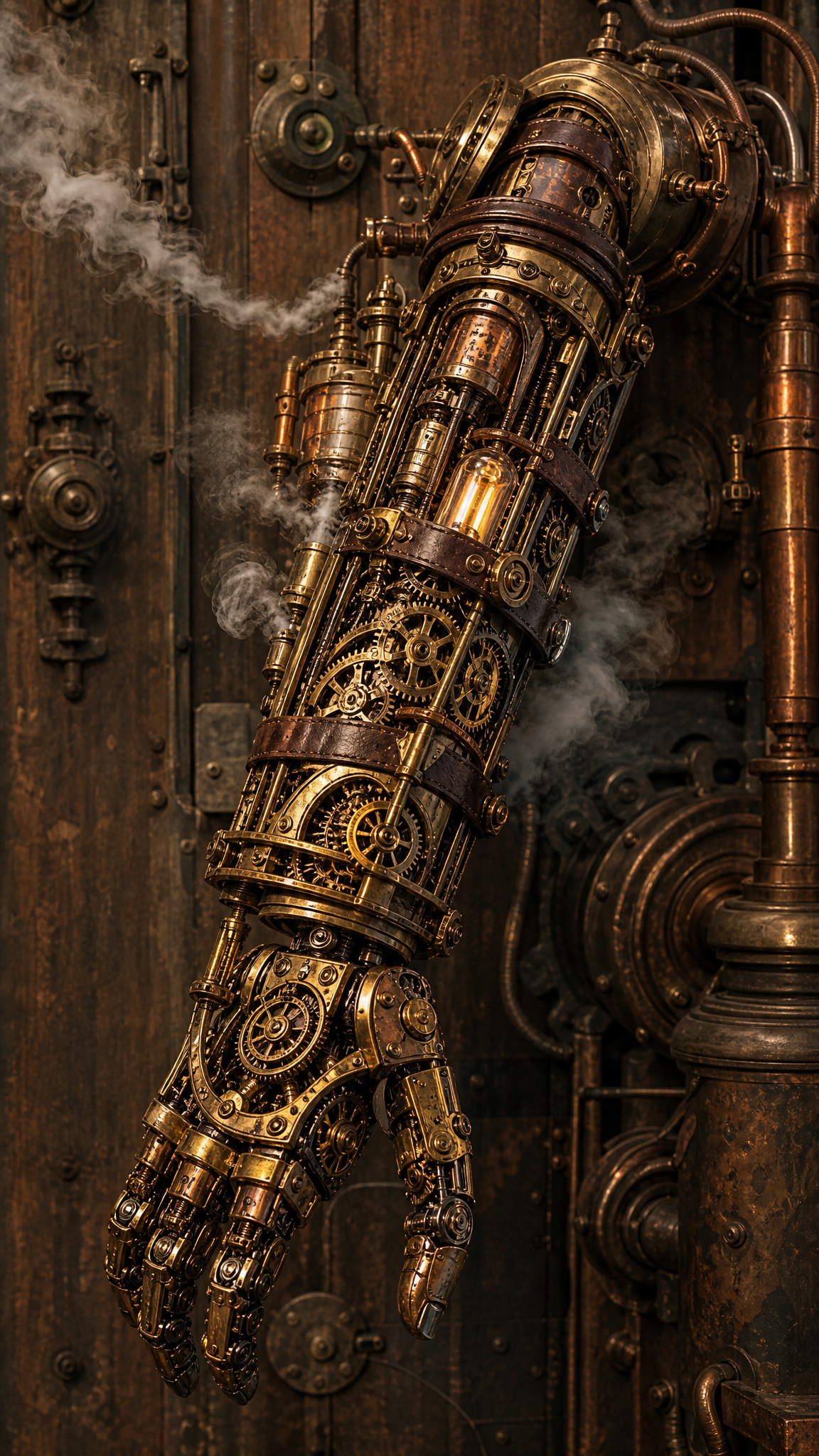
#Steampunk
Steampunk is a retro-futuristic visual style that merges Victorian-era industrial aesthetics with speculative technology powered by steam and clockwork. As wallpaper art, it features intricate brass machinery, exposed gears, ornate pipes, airships, and architecture that blends 19th-century elegance with fantastical engineering. Steampunk wallpapers are rich in mechanical detail and warm metallic tones, making them visually dense and rewarding at high resolution. The style works especially well on larger displays where the intricate details can be appreciated.
About Steampunk Art
The term 'steampunk' was coined by science fiction author K. W. Jeter in a letter to Locus magazine in April 1987, as a tongue-in-cheek variant of 'cyberpunk' to describe the Victorian-era speculative fiction he and fellow authors Tim Powers and James Blaylock were writing. The literary roots trace further back to the 19th-century scientific romances of Jules Verne, H. G. Wells, and Mary Shelley. While seminal works appeared in the 1960s-1970s, the movement coalesced as a named genre in the late 1980s. By the 1990s, steampunk had expanded from literature into visual arts, with artists creating sculptures from gears and clock parts and paintings of fantastical airships. The aesthetic draws on the Second Industrial Revolution of the 19th and early 20th centuries, combining Victorian elegance with visible, open-faced clockwork machinery. It has since become a recognized subculture with influence across fashion, product design, film, and digital art.
Visual Traits
- Brass, copper, and bronze metallic surfaces with patina and oxidation effects
- Exposed gears, cogs, clockwork mechanisms, and mechanical innards
- Steam pipes, pressure gauges, riveted boiler plates, and industrial plumbing
- Victorian architectural elements: arched windows, ornate ironwork, gas lamps
- Airships, dirigibles, and fantastical flying machines
- Polished wood, leather, and glass combined with industrial metal
- Warm color palette dominated by amber, sepia, copper-brown, and dark teal
- Ornamental detail and decorative filigree on functional machinery
- Goggles, top hats, mechanical prosthetics, and retrofitted gadgets as recurring motifs
- Layered visual complexity with foreground mechanical detail and background architecture
- Avoidance of modern plastics, LED screens, and sleek minimalist surfaces
Use Cases
Desktop wallpapers for creative professionals or hobbyists who want a richly detailed, non-generic background
Phone lock screens featuring a single mechanical object or gear arrangement as a centered focal point
Ultrawide displays where panoramic steampunk cityscapes or airship docks can span the full width
Gaming setups where the steampunk theme complements RPG or adventure game aesthetics
OLED screens where warm metallic highlights pop against deep dark backgrounds
Tablet backgrounds using vertical compositions of clock towers, mechanical interiors, or workshop scenes
Similar Styles
Different From
Prompt Guide
Prompt Directions
- Declare the material palette: 'brass and copper machinery,' 'polished wood and leather panels,' 'riveted iron and glass'
- Specify the scene type: 'steampunk workshop interior,' 'Victorian airship dock at sunset,' 'clockwork city panorama'
- Request period-appropriate detail: 'exposed gears,' 'steam pipes,' 'gas lamp lighting,' 'ornate Victorian ironwork'
- Control the color temperature: 'warm amber and sepia tones,' 'copper and dark teal palette,' 'golden hour lighting on brass'
- Add atmospheric depth: 'steam clouds,' 'dusty light shafts through factory windows,' 'oil-lamp glow'
- For wallpaper usability, balance detail density: request one area of high mechanical complexity and one area of simpler background for icon placement
Tips
- Internal editorial suggestion: The most convincing steampunk scenes make the machinery look functional rather than decorative. Gears should mesh, pipes should connect, and gauges should read pressure levels.
- Internal editorial suggestion: Warm directional lighting (golden hour, oil lamp, furnace glow) is the fastest way to push a generic mechanical scene into authentic steampunk territory.
- Internal editorial suggestion: For desktop wallpapers, a steampunk workshop or control room with one bright window or lamp source naturally creates a dark zone for icons and a detailed zone for visual interest.
- Internal editorial suggestion: Adding subtle steam or smoke particles in the mid-ground creates atmospheric depth and softens the transition between detailed foreground and simpler background.
Recommended Keywords
Avoid
Common Failures
- Generic fantasy castle with a few gears glued on — the machinery must be integrated into the scene structurally, not decoratively added
- Color palette drifting cold and blue — steampunk is warm; keep brass, amber, copper, and sepia dominant
- Gears floating in space with no mechanical purpose — each gear should visually connect to a mechanism or structure
- Over-cluttered composition with no breathing room — even dense steampunk scenes need one quieter zone for wallpaper usability
- Accidentally producing dieselpunk or cyberpunk — avoid Art Deco streamlining or digital-neon elements to stay in the Victorian-steam lane