#Ukiyo-e
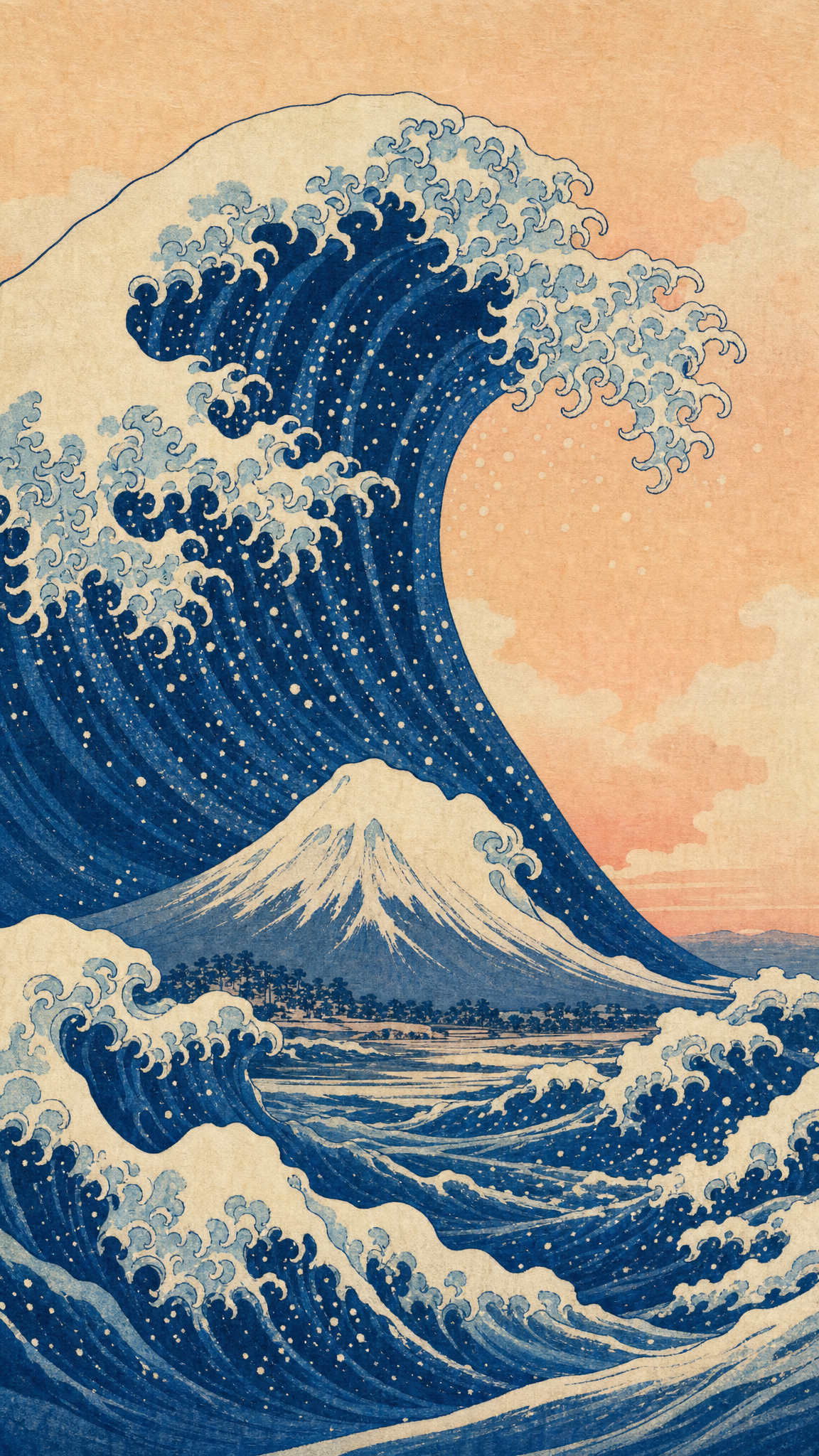
Ukiyo-e wallpapers bring the visual world of Japan's Tokugawa period (1603-1867) to the digital screen — bold woodblock outlines, flat color planes, dramatic compositions of landscapes and figures, and the unmistakable aesthetic of 'pictures of the floating world' that depicted the entertainment quarters of Edo (modern Tokyo). Originating as a style that mixed the realistic narrative of emaki picture scrolls with the decorative sensibility of the Momoyama and early Tokugawa periods, ukiyo-e evolved from monochrome prints by Hishikawa Moronobu through two-color experiments by Okumura Masanobu to the full polychrome nishiki-e prints introduced by Suzuki Harunobu in 1765. The form reached its artistic zenith in the works of Kitagawa Utamaro, Katsushika Hokusai, and Utagawa Hiroshige, whose landscapes later profoundly influenced European Impressionism and Art Nouveau. As wallpaper art, ukiyo-e imagery delivers striking compositions of crashing waves, snow-capped mountains, cherry blossoms, kabuki actors, and courtesans rendered with the woodblock print's characteristic crisp outlines, layered color registration, and masterful negative space.
About Ukiyo-e Art
Ukiyo-e, meaning 'pictures of the floating world,' is one of the most important genres of art of the Tokugawa period (1603-1867) in Japan. The style is a mixture of the realistic narrative of emaki (picture scrolls) and the decorative style of the Momoyama and early Tokugawa periods. Ukiyo-e depicted the entertainment quarters of Edo (modern Tokyo), with common subjects including courtesans, kabuki actors, kabuki scenes, and erotica. Hishikawa Moronobu is generally credited as the first master of ukiyo-e. The transition from single-color to two-color prints was achieved by Okumura Masanobu. In 1765, full polychrome prints known as nishiki-e ('brocade pictures') were introduced by Suzuki Harunobu. According to the Metropolitan Museum of Art, the first polychrome prints were calendars made on commission for wealthy patrons in Edo. The Met also notes that woodblock prints were first used in Japan in the 8th century for Buddhist scriptures, and that Tawaraya Sotatsu used wood stamps in the early 17th century. The essence of the ukiyo-e tradition is embodied by three later masters: Kitagawa Utamaro, known for his intimate portraits of courtesans; Katsushika Hokusai, whose 'Thirty-six Views of Mount Fuji' series (including 'The Great Wave off Kanagawa') became globally iconic; and Utagawa Hiroshige, whose landscape series 'The Fifty-three Stations of the Tokaido' captured the Japanese countryside with atmospheric sensitivity. When ukiyo-e prints reached Europe in the mid-19th century, they profoundly influenced Impressionist and Post-Impressionist painters including Monet, Van Gogh, and Degas, as well as the Art Nouveau movement.
Visual Traits
- Bold black outlines defining forms with crisp woodblock precision
- Flat color planes without Western-style shading or chiaroscuro
- Dramatic compositional cropping with asymmetrical framing
- Layered color registration from the woodblock printing process
- Masterful use of negative space and empty backgrounds
- Landscape elements: crashing waves, Mount Fuji, cherry blossoms, pine trees, bridges
- Figure subjects: kabuki actors in dramatic poses, courtesans in elaborate kimono
- Atmospheric gradations achieved through bokashi (graduated color printing)
- Calligraphic text elements and artist seal marks integrated into the composition
- Seasonal and weather effects: rain lines, snow accumulation, mist, moonlight
- Compressed perspective and elevated viewpoints replacing Western vanishing point
- Pattern-rich textile details on kimono and interior furnishings
Use Cases
Japanese art and culture enthusiast desktop backgrounds
East Asian studies student and educator device wallpapers
Printmaking and illustration artist workspace backdrops
Zen and meditation-themed minimalist lock screens
Travel and landscape photography enthusiast themed wallpapers
Anime and manga fan complementary aesthetic wallpapers
Similar Styles
Different From
Prompt Guide
Prompt Directions
- Specify the ukiyo-e subject type: 'Hokusai great wave style', 'Hiroshige landscape series', 'bijin-ga courtesan portrait', 'kabuki actor print', 'Mount Fuji woodblock composition'
- Include printing technique cues: 'woodblock print style', 'nishiki-e polychrome', 'flat color planes with bold outlines', 'bokashi gradient sky'
- Reference specific masterworks: 'Great Wave off Kanagawa style', 'Thirty-six Views of Mount Fuji', 'Fifty-three Stations of the Tokaido atmosphere', 'Utamaro beauty portrait'
- Use composition directives: 'asymmetrical cropping', 'elevated viewpoint', 'dramatic negative space', 'calligraphic text elements in composition'
- Add environmental and seasonal cues: 'cherry blossom spring scene', 'snow falling on bridge', 'rain lines over village', 'moonlit coastal landscape', 'autumn maple leaves'
Tips
- Internal editorial suggestion: cross-link ukiyo-e wallpapers with 'landscape', 'watercolor', 'line-art', and 'minimalist' tag pages
- Internal editorial suggestion: 'The Great Wave' is one of the most-searched artworks globally, driving massive long-tail traffic
- Internal editorial suggestion: ukiyo-e influenced both Impressionism and Art Nouveau, creating natural cross-linking opportunities
- Internal editorial suggestion: seasonal Japanese imagery (cherry blossom, autumn leaves, snow scenes) drives recurring seasonal search traffic
Recommended Keywords
Avoid
Common Failures
- Too much shading: AI tends to add Western-style light and shadow, but ukiyo-e uses flat color planes without chiaroscuro
- Wrong perspective: AI defaults to single-point perspective, but ukiyo-e uses compressed elevated viewpoints and parallel projection
- Generic Japanese instead of ukiyo-e: AI may produce anime-style or generic 'Japanese' imagery rather than authentic woodblock print aesthetics
- Missing outline quality: the crisp black keyblock outline is essential to ukiyo-e but AI often produces soft blended edges